
Jump to
The company
About Houston Lightscapes
More than 30 years in Greater Houston. Family-owned, specialising in outdoor lighting design, installation, repair, maintenance and system upgrades. About Houston Lightscapes
It is the only service. Outdoor lighting is not one line on a list of unrelated work — it is what the company does.
- Landscape lighting design and installation
- Architectural and accent lighting
- Tree lighting and moonlighting
- Patio and outdoor living lighting
- Pool and water feature lighting
- Pathway, driveway and entry lighting
- Smart and colour-changing lighting
- Commercial outdoor lighting
- Repair, maintenance and LED upgrades
Yes. Residential work covers homes, estates, pools, patios, trees, gardens and outdoor living space; commercial work covers facades, entrances, signs, landscaping, walkways, courtyards and gathering areas. Residential · Commercial
Getting started
Before anything gets designed
Yes. We walk the property and talk about what you would like to highlight, how you use the outdoor space and what you want it to look like after dark. Our Design Process
No. No fixture types, beam spreads or transformers required. “The front of the house looks too dark” or “our backyard disappears after sunset” is enough to start from — working out which technique produces that result is our job.
We go through your goals and look at what the property actually offers: architecture, planting, trees, walkways, driveways, entrances, patios, pools, outdoor kitchens, gardens, courtyards and water features. The lighting plan comes out of that.
Yes. We do not believe every home needs the same number of fixtures in the same positions. Landscape Lighting Design
Design
Lighting design questions
There is no standard number. It depends on the size of the property, the architecture, the planting, the trees, the outdoor living areas and the effect you want. More fixtures do not automatically make a better design — fewer, better placed, often produce a stronger result.
No. Good lighting uses darkness as well as light. If everything is equally bright the property reads flat, so we choose what deserves attention and leave other areas dark for contrast and depth.
- Architecture, stone, brick, columns
- Trees, gardens, specimen planting
- Patios, pools, outdoor kitchens, pergolas
- Walkways, driveways, gates, entrances
- Fountains, sculpture, courtyards
It can make more of the property visible after dark. Lighting something farther away — a garden beyond the pool, a mature tree at the back — carries the eye past the patio instead of stopping it at the edge of the darkness. Patio & Outdoor Living Lighting
Yes. Large windows and glass doors frame the outdoor areas after sunset, so a lit tree, courtyard or pool becomes part of the view from the living room, kitchen or bedroom.
Techniques
Uplighting, grazing and moonlighting
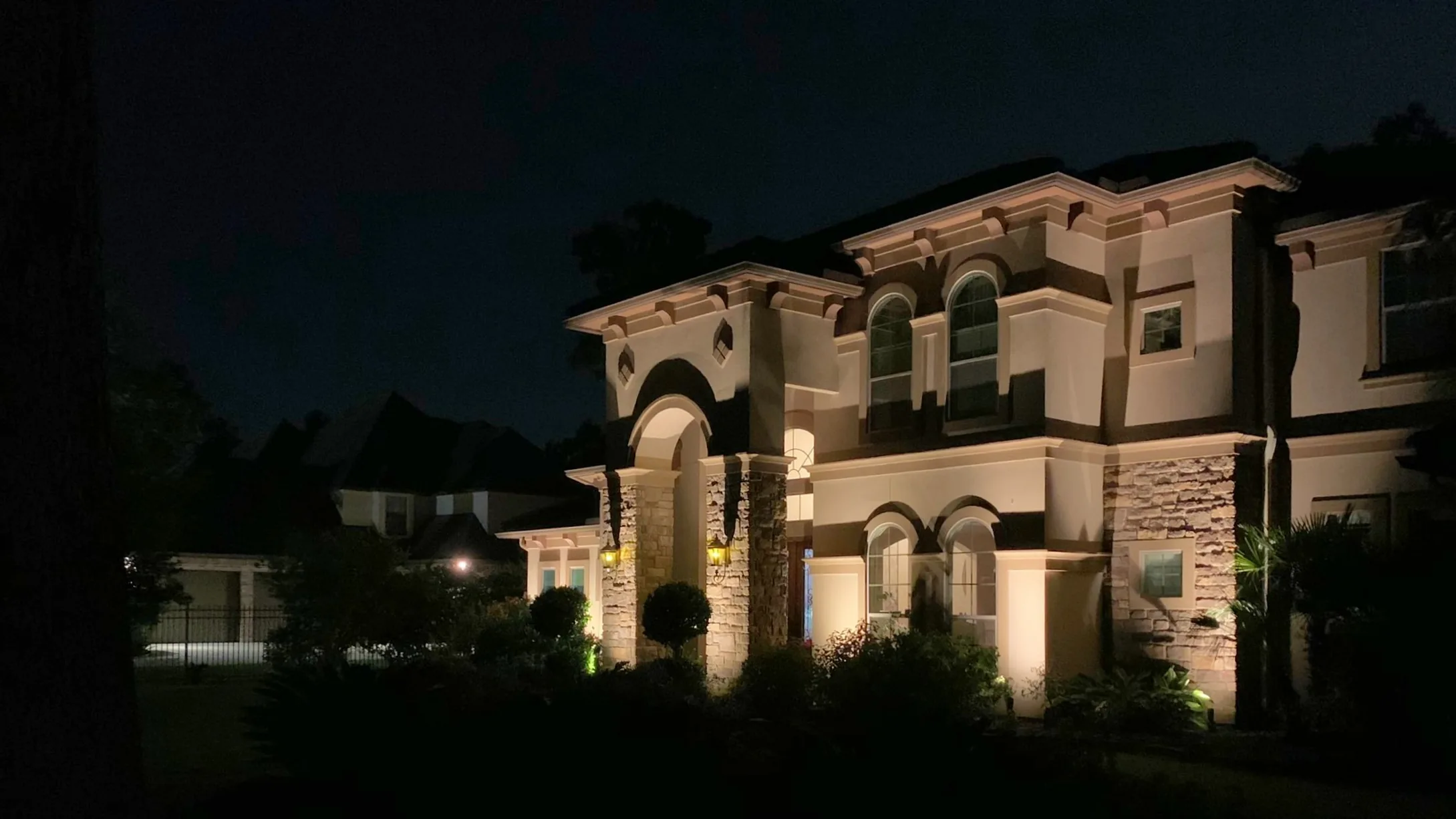
Light used on the structure itself — stone, brick, columns, walls, arches, gables and entrances — so the building is still legible at night. Architectural & Accent Lighting
Attention on one feature: a sculpture, fountain, specimen tree, stone wall or architectural detail. It works as part of the larger system rather than as an isolated spotlight.
A fixture placed below the feature and aimed up — used on elevations, columns, walls, trees and palms. Position and beam spread decide whether the result is dramatic or subtle.
A fixture placed close to a textured surface so the light travels across it. The small shadows are the point: stone, brick, wood and masonry gain dimension instead of simply getting brighter.
Yes, and they are often the strongest feature on the property after dark — uplighting reveals the trunk, the branch structure, the canopy and the height. Tree Lighting & Moonlighting
Fixtures mounted high inside a suitable mature tree and aimed down. The light passes through the branches and lays soft patterns of light and shadow over lawns, walkways, patios, driveways and gardens.
No. Size, branch structure, canopy, location, mounting points, the area being lit and future access for maintenance all decide it. We look at the tree before recommending it.
Sometimes — uplighting shows the tree, moonlighting lights what is underneath it. Whether both make sense depends on the tree and the rest of the design.
Patios & pools
Outdoor living questions
Yes — that is usually the brief. Several layers of softer light around the space work better than one bright fixture over it, which turns a patio into an outdoor room with the lights on.
Yes: grill, prep areas, counters, sink, bar, dining and the walkways around them. Task light where it is needed, balanced against softer light in the rest of the backyard.
Yes, either around it or integrated into it. The right approach depends on how the pergola is used and how it connects to the rest of the garden.
We design the landscape lighting around the pool environment — trees, planting, patios, walkways, architecture and water features. Pool & Water Feature Lighting
No. Built-in underwater pool lighting is a different scope and usually belongs with the pool contractor or another qualified trade.
Yes. Fountains, waterfalls and ponds are part of the design, considered together with the water, the planting around them and the angles they are actually seen from.
Water reflects. A lit tree, fountain or facade on the far side of the pool doubles in the surface, which is often the best way to improve how the pool itself looks at night.
Approaches
Pathways, driveways and entries
Yes — to define walkways and transitions through the property, as part of the larger design rather than as a row of markers. Pathway, Driveway & Entry Lighting
There is no single spacing rule. Fixture type, output, the layout of the walk, the planting and whatever else is lit nearby all change the answer. The aim is fewer fixtures than the property could take.
No. Alternating fixtures, or borrowing light from nearby trees and architecture, usually reads more naturally than a matched pair every few metres.
Yes, usually by combining tree lighting, moonlighting, gate and column lighting and selected low-level fixtures — guiding the eye along the drive instead of lining it with identical lights.
Yes: columns, stonework, planting, the approach itself, address features and the rest of the entrance.
Installation
How the system is built
Professional low-voltage LED outdoor lighting. Landscape Lighting Installation
High-quality solid brass fixtures for residential landscape lighting; the exact fixture depends on the effect and the location.
It stands up to the outdoor environment and develops a natural patina over time, rather than relying on a thin coating to keep looking right.
A transformer steps the supply down to the lower voltage the fixtures run on. Transformer, wiring, fixtures and controls work as one system.
Wherever it can serve the system properly — decided by the property, the power access, the lighting layout and the load.
By the number of fixtures, the load, the wire runs, the size of the property, the zones, the controls and whether the system is likely to be extended later.
For typical residential installations, roughly 8 to 10 inches below ground where conditions allow. Actual depth varies with the site.
It should not. The wiring goes in through narrow openings in the soil and the surface is closed back up. The intention is that you notice the lighting, not the route it took.
Many residential installations are finished in a day or two. Large properties, complex systems, tree-mounted lighting, commercial projects and work coordinated with other trades take longer.
After dark
The night-time review
Yes. Outdoor lighting cannot be judged in daylight, so the night-time review is part of the job rather than an extra. Our Design Process
Fixture direction and beam placement, bright spots and dark gaps, glare, shadows, how much of the architecture and the trees are covered, and the balance between one part of the property and the next.
Yes — and they usually are. A few degrees of aim or half a metre of position changes the finished result more than most people expect.
LED & controls
LED, controls and colour
Yes — low-voltage LED systems throughout.
Generally yes: less electricity for comparable output and a longer service life. Actual consumption depends on the size of the system and the hours it runs.
It does not have to. We normally use warm white around 2700K on residential work; other colour temperatures are used where the architecture calls for it.
Many can. Some fixtures take a compatible LED lamp, others need replacing — we inspect the system first. LED Upgrades & Retrofitting
Not necessarily. Fixtures in good condition and compatible with the upgrade can stay; we also look at the wiring, the transformer, the controls and the design itself.
Yes — timers, photocells, astronomical schedules that follow sunset, or smart controls. Smart & Color-Changing Outdoor Lighting
With compatible equipment, yes. What you can actually control depends on the system that is installed.
With a properly designed system, yes. Zones are useful when the front elevation should run every evening but the patio and pool lighting only when you are out there.
Yes, on suitable systems — for holidays, parties, game days and events, while the everyday setting stays warm and natural.
Repair
Something has stopped working
Yes — troubleshooting and repair on existing systems. Outdoor Lighting Repair
Yes, including systems put in by a builder or another company. You do not need to know who installed it.
Fixtures failing together usually points at something shared: the wiring, a connection, the transformer, the controls or one run. Troubleshooting finds which.
Connections, voltage, wiring, the fixtures themselves, LED components or the transformer. The system should be inspected before parts get replaced at random.
Yes. We inspect damaged or exposed low-voltage wiring and decide whether it needs repair, replacement or simply reburying.
We troubleshoot transformer faults and say whether the unit can stay in service or should be replaced.
Maintenance
Keeping a system right
Yes. Even LED systems need occasional service, because the property around them keeps changing. Landscape Lighting Maintenance
- Cleaning lenses
- Repositioning fixtures and redirecting beams
- Checking voltage across the system
- Reburying exposed wire
- Resetting timers and schedules
- Clearing planting that has grown over fixtures
There is no single schedule. Planting, tree growth, the age of the system, irrigation and how much landscape work happens all change it. If the lighting no longer looks or works the way it did, that is the schedule.
Because landscaping carries on growing after the lighting goes in. Shrubs, groundcover and canopies eventually block fixtures, which then need cleaning, redirecting or moving.
Yes, ongoing maintenance options are available — ask for the current terms when you call.
Existing systems
Lighting that is already there
Yes. We inspect the existing system even when nobody knows who installed it.
Often. It depends on transformer capacity, the wiring, the controls, the existing fixtures and the load already on the system.
That depends on what is there. Fixtures, wiring, transformer, controls, age and the original design all matter, and the answer is often repair, maintenance or a retrofit rather than starting again.
Commercial
Commercial property
Yes, on appropriate commercial properties. Commercial Outdoor Lighting
Building facades, entrances, monument signs, landscaping, trees, walkways, courtyards, fountains, outdoor gathering spaces and campuses.
Yes, the same as residential — maintenance and repair on appropriate commercial outdoor lighting.
No. Large high-voltage parking-lot and roadway lighting is a different electrical scope. Send us the project details and we will say whether it is something we do.
Cost
Cost and phasing
It depends on the property: the number and type of fixtures, the size of the site, the techniques used, the transformer and wiring, the controls, tree work and what already exists. A consultation is the shortest route to a real number.
No. The number and type of fixtures should come out of the design, not out of a package chosen before anyone has seen the property.
Often, yes — front yard first, then the backyard, the pool or the trees. Tell us during the design if you expect to expand, so the system is sized with that in mind.
Areas & proof
Service areas, projects and reviews
Houston and the surrounding communities, with Memorial Villages, Tanglewood, River Oaks, West University, Bellaire, Spring Branch and the Energy Corridor among the priority areas. All Service Areas
Yes, well beyond them. Location, scope and type of work affect availability — ask if you are not sure.
Yes. Residential and commercial projects, plus before and after.
Please do — it is the fastest way to show us the effect you are after. The lighting still gets designed around your property rather than copied from someone else’s.
On the Reviews page, with links to the third-party profiles.
Not answered
Still have a question
Most of the useful answers depend on the property: what is already there, what the trees are doing, how the outdoor space is used, what the existing system can still carry.
Call and describe it, or book a consultation and we will walk it with you. Either way the first conversation costs nothing and usually settles the question faster than a page can.
Free consultation
Start with the property
We walk the site, talk about what you want to see after dark, and design the lighting around it.