
Landscape Lighting Installation
The design built on site: fixtures, wiring, transformers, controls and the night-time set-up.
We look at the property as a whole — architecture, landscaping, mature trees, walkways, driveways, patios, pools, entrances — then decide what should be lit, how, and what should stay in shadow.
Nobody looks at a well-lit property and thinks about fixtures. They notice the house, the trees, the stonework, the path to the front door. That is the point.
A good design draws attention to the property rather than to the equipment making the light. We use fixture position, beam angle, lighting level and technique to build layers: some areas brighter, some a soft glow, some deliberately dark. Those differences are what create depth after sunset.
There is no standard plan that fits every house. Two homes on the same street can have completely different architecture, landscaping, trees and outdoor living spaces. So we do not start by deciding how many fixtures you need — we start by understanding the property.
And we want to know what matters to you. Maybe it is the oaks in the front yard, maybe the stonework around the entrance, maybe a backyard that disappears entirely after sunset. Those details shape the design.
Different homeowners want different things: showcase the architecture, improve nighttime curb appeal, highlight mature trees, warm up the front entrance, add atmosphere around a pool, define walkways and steps, or connect several outdoor areas into one nighttime environment.
You do not need to know which fixtures or techniques will get you there. That is our job. You tell us what you want to experience when you look at the property at night.
The most important part of the design is knowing what not to light.
A property where every surface is equally bright looks flat. Contrast between lit and darker areas is what gives it depth. A tree lit in the distance makes a backyard feel deeper than if everything up to the property line is equally bright. A stone column stands out more when the wall beside it gets less light. A softly lit path leads the eye toward a brighter entrance.
This is why more fixtures do not automatically make a better design. Often the better answer is fewer lights in better places.
Different parts of a property call for different techniques, and a complete design usually combines several rather than repeating one everywhere.
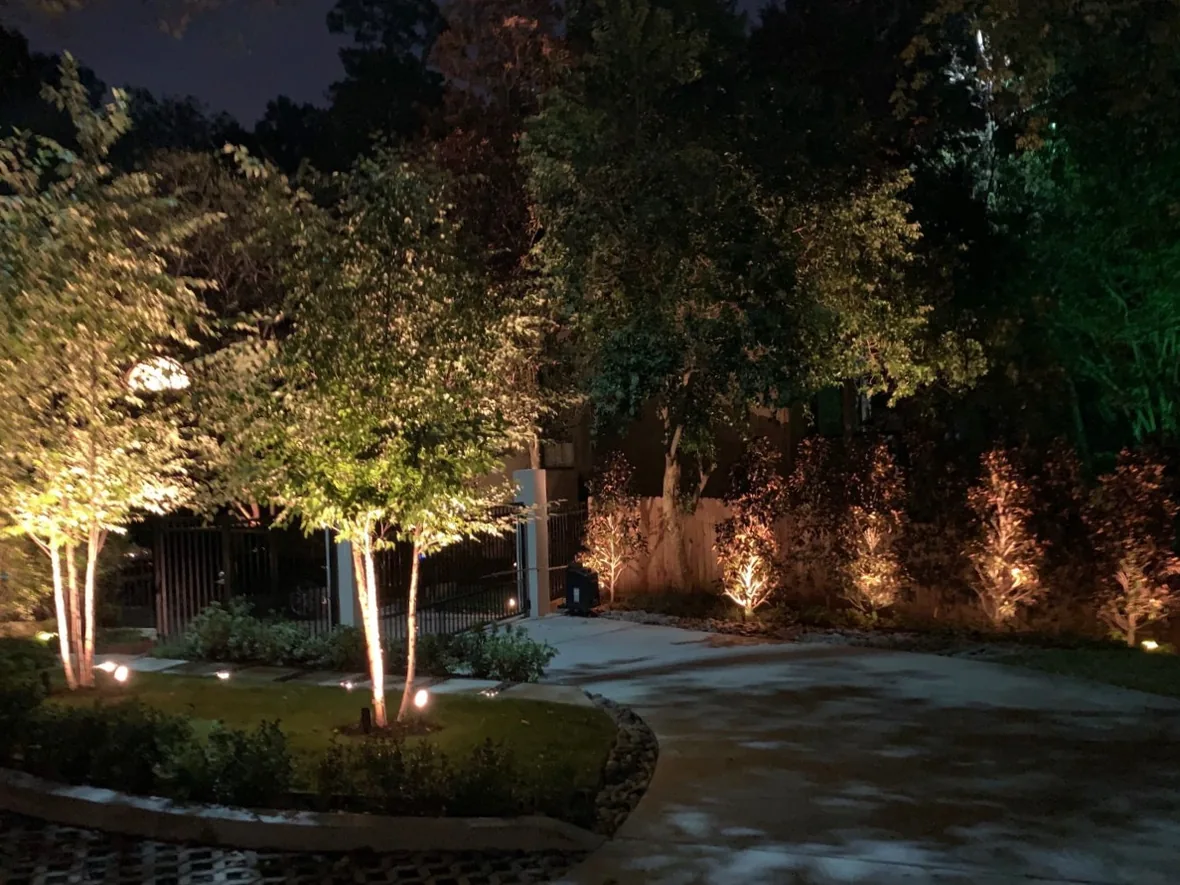
Fixtures near ground level aimed upward — architecture, columns, walls, large trees, palms, sculptures. Position and beam spread decide how dramatic or subtle the result is.
A source placed above the area and aimed down. Useful over patios, walkways, gardens and drives, and it keeps the fixture itself from becoming the feature.
Downlighting from high inside a mature tree, through the branches, producing soft patterns of light and shadow on the ground below.
Light placed close to a textured surface and pushed across it, so stone, brick, wood or a textured wall gains dimension instead of simply getting brighter.
Attention on one feature — a specimen tree, sculpture, fountain, entry. It works when it supports the whole design instead of becoming an isolated spotlight.
Useful light along walkways and transitions — without the row of runway markers. Spacing, nearby planting and existing light sources all matter.
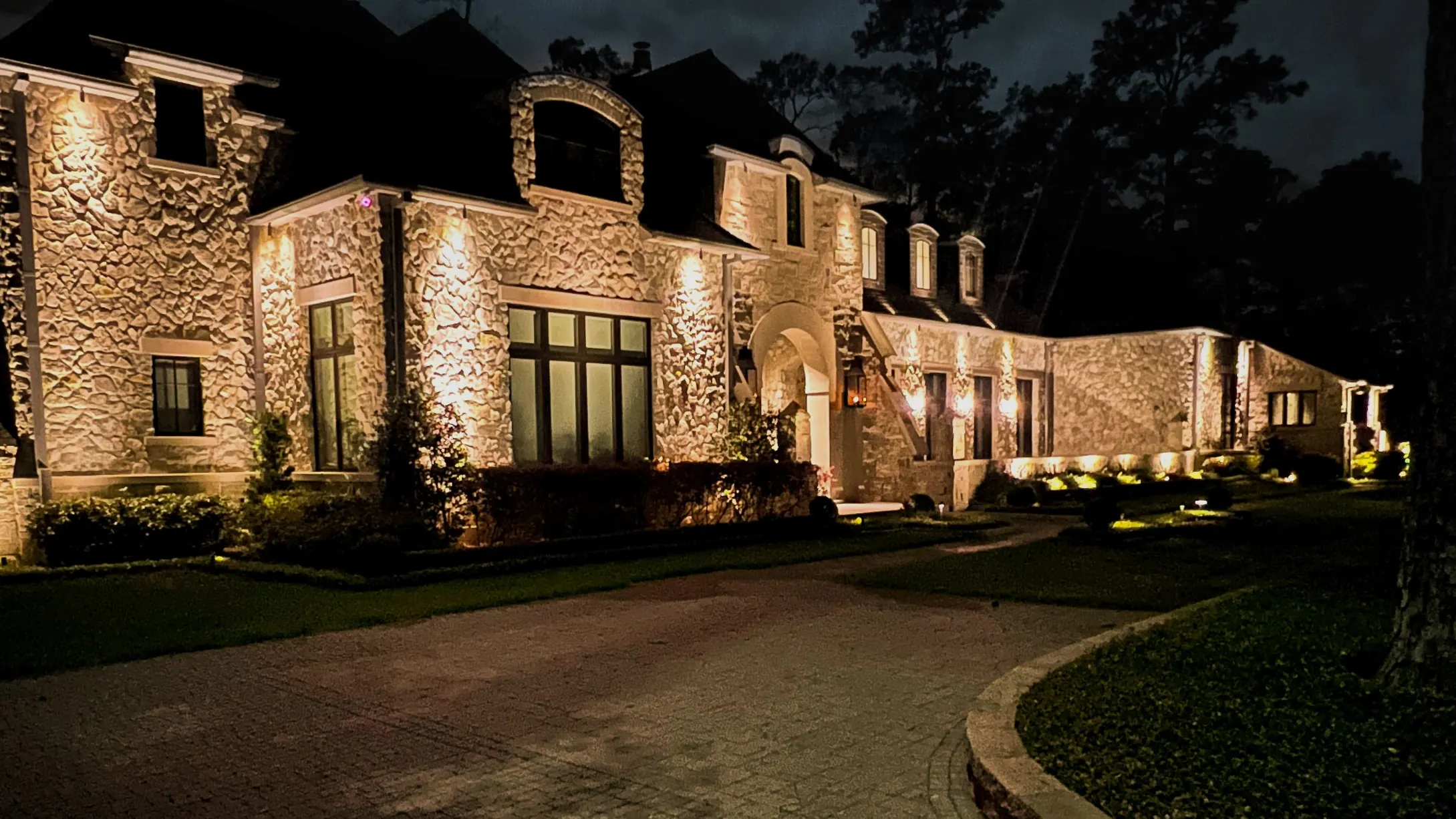
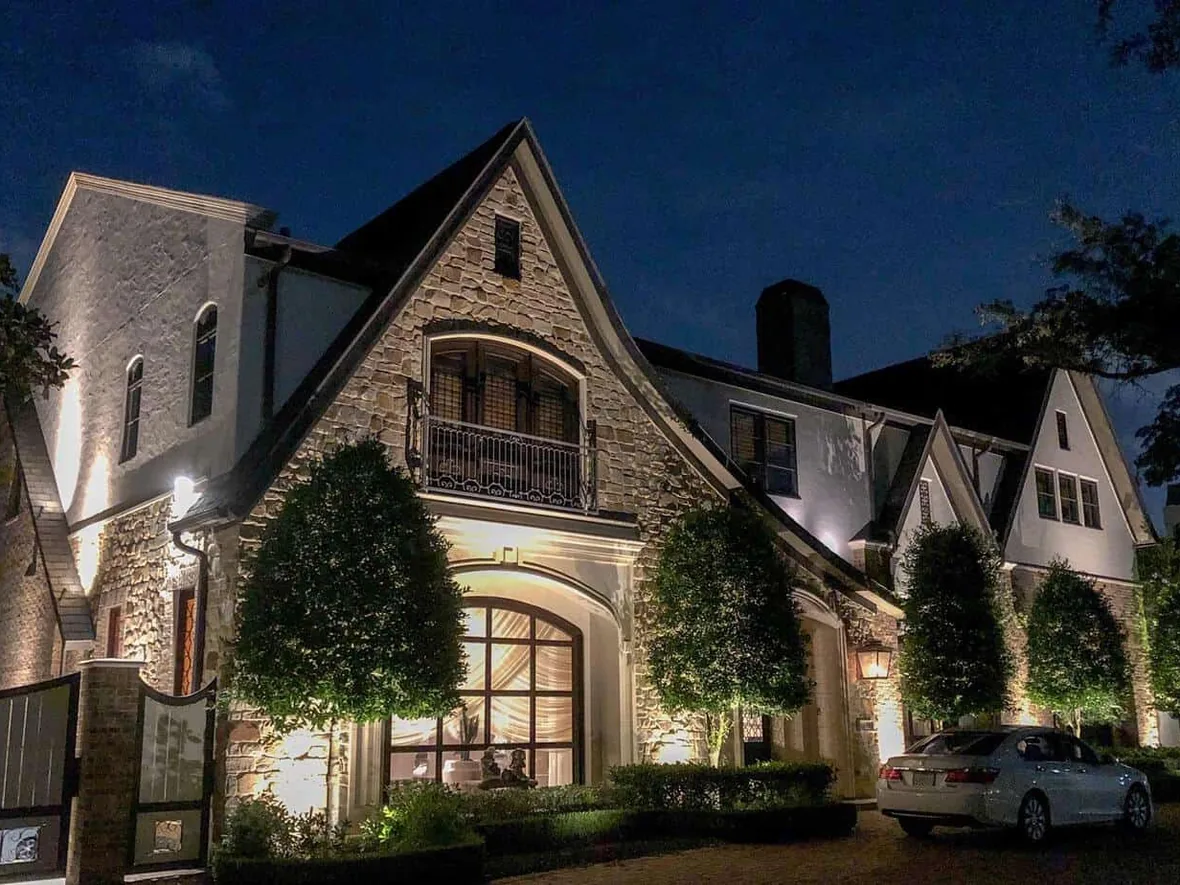
Landscape lighting is not limited to plants and trees. The house is usually the largest and most important feature on the property: columns, arches, stone walls, brickwork, rooflines, gables, entryways, courtyards.
Placement decides the result. A fixture too close, too far or at the wrong angle produces harsh hot spots and unwanted shadows; a carefully positioned one reveals the shape, texture and character of the architecture.
Houston has a lot of properties with large established trees, and they can carry the whole nighttime design. A big oak may want several positions that reveal the trunk, the branching structure and the canopy. A tall palm is a completely different shape and needs a different fixture position and beam angle. Trees can also host moonlighting fixtures where conditions allow.
The goal is not to put a spotlight on a tree. It is to use the tree as part of the landscape.
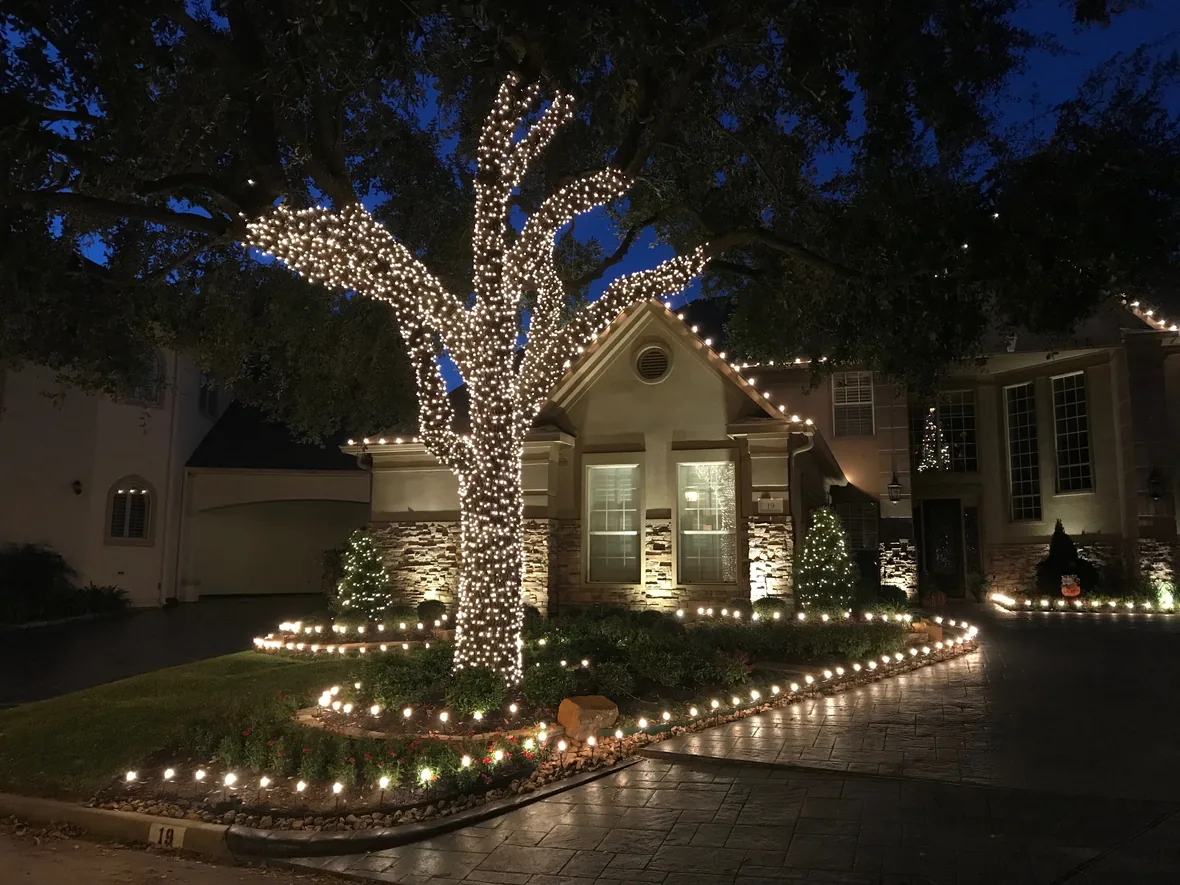
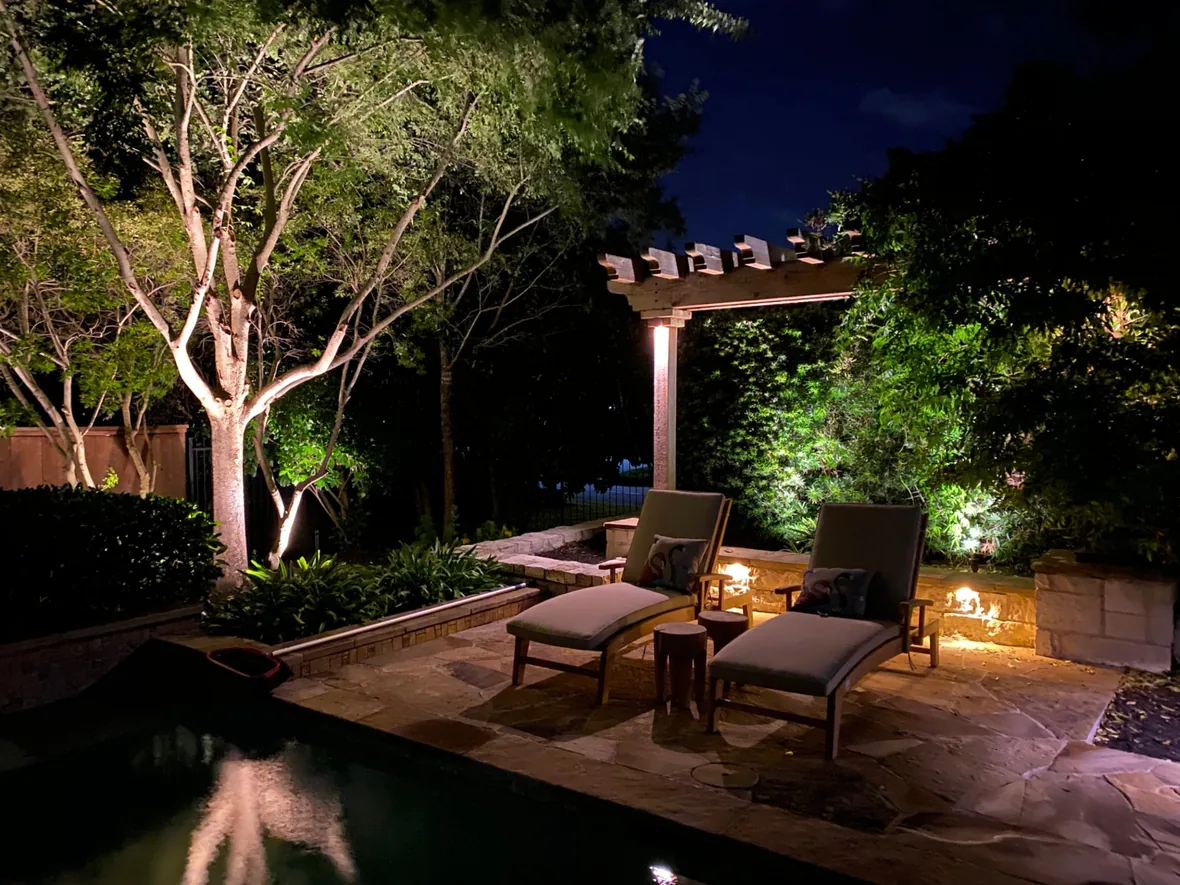
Design changes when the space is one people sit in. A patio needs enough light to be comfortable without feeling like an indoor room with everything turned up. We tend to light around the space — surrounding trees, downlighting, garden and architectural lighting, step lighting, task light in an outdoor kitchen — so the patio stays connected to the landscape beyond.
Water behaves differently from solid surfaces: it moves and reflects, which adds motion and depth. We light the feature and the area around it, so a pool does not read as one bright object surrounded by darkness.
Some of the best views of a lighting system are from indoors. Without exterior light, large windows and glass doors simply mirror the room at night; with it, they frame the landscape. Living rooms, dining rooms, kitchens, primary bedrooms, covered patios and window walls are all worth considering as viewing positions when deciding what gets lit.
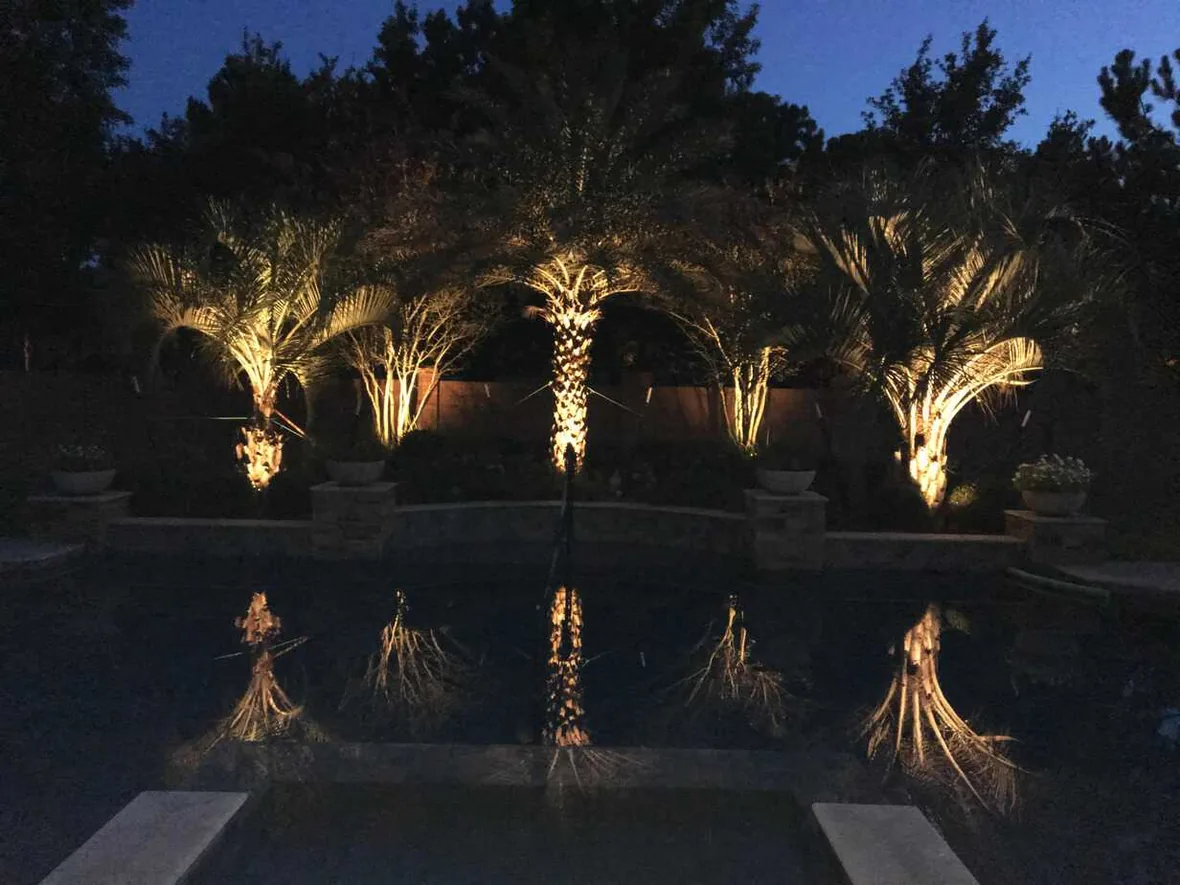
Front-yard lighting is designed around the approach: architecture, entrance, driveway, walkway, trees, gardens, gates and the view from the street. The goal is a warm, polished first impression that guides people toward the door.
Backyard lighting is about experience — what you see while sitting outside and how you move between areas. Lit focal points beyond the seating area make a property feel considerably larger after sunset.
Established neighbourhoods bring mature trees and dense planting; newer properties bring young landscaping that will change substantially within a few years. The climate also means patios, pools and outdoor kitchens get used most of the year.
Heat, humidity, heavy rain, irrigation, landscaping activity and year-round growth are exactly why fixture quality, placement and ongoing adjustment matter here.
Plants do not stop growing once the system is in. Shrubs get taller, canopies widen, beds get redesigned. A fixture that lit a small tree perfectly on day one may need repositioning as that tree matures. Good design allows for growth; maintenance keeps the lighting moving with the landscape.
Once the plan is set, the project moves into installation: fixture placement, wiring, transformers, connections, controls, positioning and system testing. We use high-quality brass fixtures on residential systems and bury wiring carefully to keep disruption to established lawns and planting to a minimum.
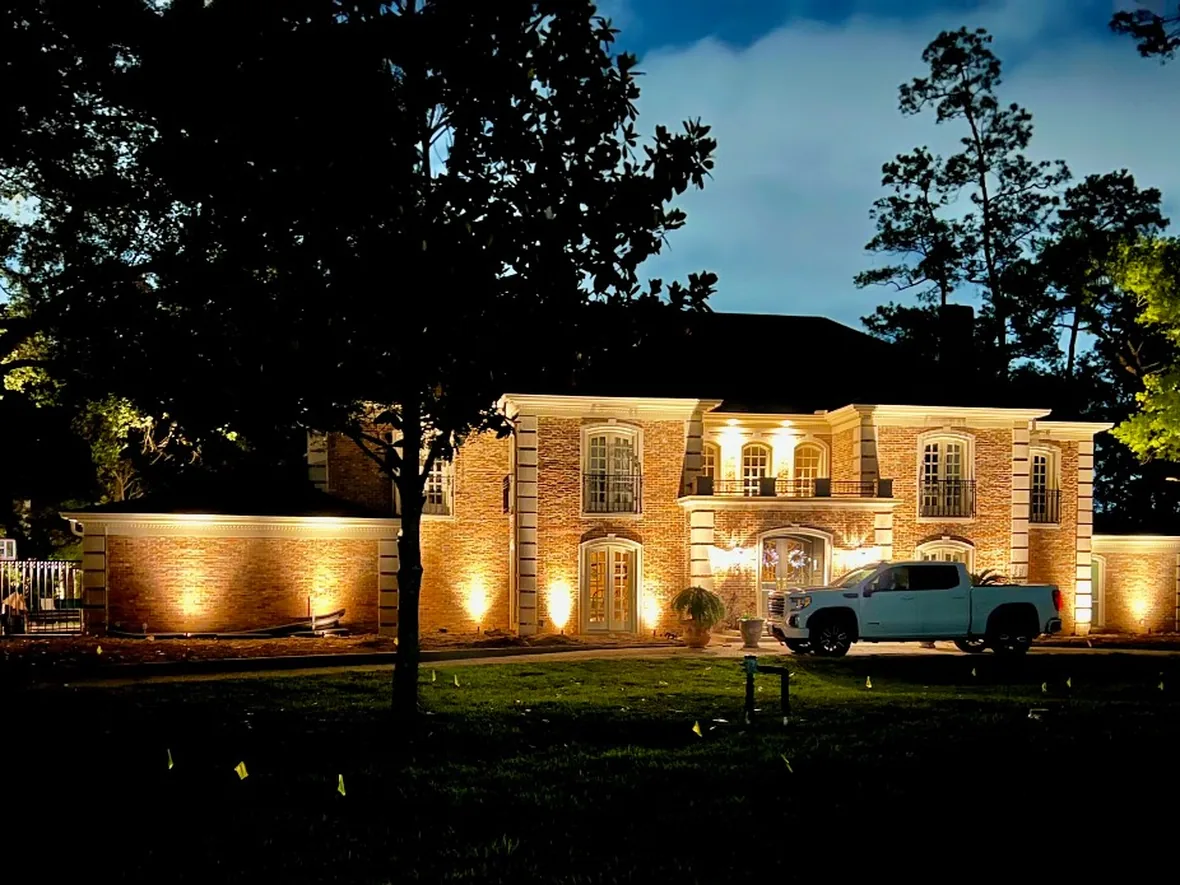
Outdoor lighting cannot be judged in daylight. After installation we review the system after dark and look at fixture direction, beam placement, brightness, shadows, hot spots, viewing angles and the balance between areas. If a fixture needs to move or an angle needs to change, it changes. Those final details are usually what separates a good result from a flat one.
It is entirely possible to place lights around a property without producing a design, and the difference shows after dark. Instead of asking only “where can we put a light?”, the questions are: what should someone see from here, what should draw the eye next, is this area too bright against the one beside it, does this tree create depth, can people use this space without destroying the atmosphere?
Those decisions are what turn a pile of fixtures into a complete design. Houston Lightscapes has specialised in outdoor lighting for more than thirty years — it is not an add-on service for us, it is the whole business.
The design built on site: fixtures, wiring, transformers, controls and the night-time set-up.
Columns, stone, brick, rooflines and entries — the house as the largest feature on the property.
Uplighting mature trees, and moonlighting from high in the canopy down through the branches.
Enough light to use the space at night without turning it into an indoor room.
Moving water reflects: lighting the feature and everything around it so it is not one bright object.
Cleaning, repositioning and adjustment as the planting grows past where the fixtures were aimed.
Planning how outdoor areas will be illuminated after dark: which features get light, which techniques are used, where fixtures sit, and how every lit area works with the others.
Yes. Every project starts with your goals and an evaluation of the property. The design drives fixture location, technique, beam direction and the relationship between areas.
There is no standard number. It depends on the architecture, landscaping, property size, what is being lit, the effect you want and the budget. More fixtures do not automatically make a better design.
Absolutely — the consultation is collaborative. We want to know which parts of the property you enjoy, where you spend time outside and what you would change about how it looks at night.
That is completely normal. Most homeowners know they want the property to look better after dark without knowing which techniques get them there. We evaluate the property, discuss the goals and propose a design.
Yes — most of our work is existing homes and landscapes. The design is built around the architecture, trees, planting and outdoor living areas already on the property.
Yes, and earlier is better. If you are planning landscaping, a pool, an outdoor kitchen or a patio, involving the lighting designer early lets fixture placement and wiring be coordinated with the rest.
Yes. We can design one area or a complete plan covering front, back, sides, outdoor living areas and landscaping.
Yes — design and professional installation. Landscape Lighting Installation
Yes. Fixtures need cleaning, repositioning and adjustment as plants and trees grow; that is what ongoing maintenance is for. Landscape Lighting Maintenance
You don’t need to know whether a tree wants uplighting or moonlighting, and you don’t need to arrive with a finished plan. Show us the property and tell us how you use it.