
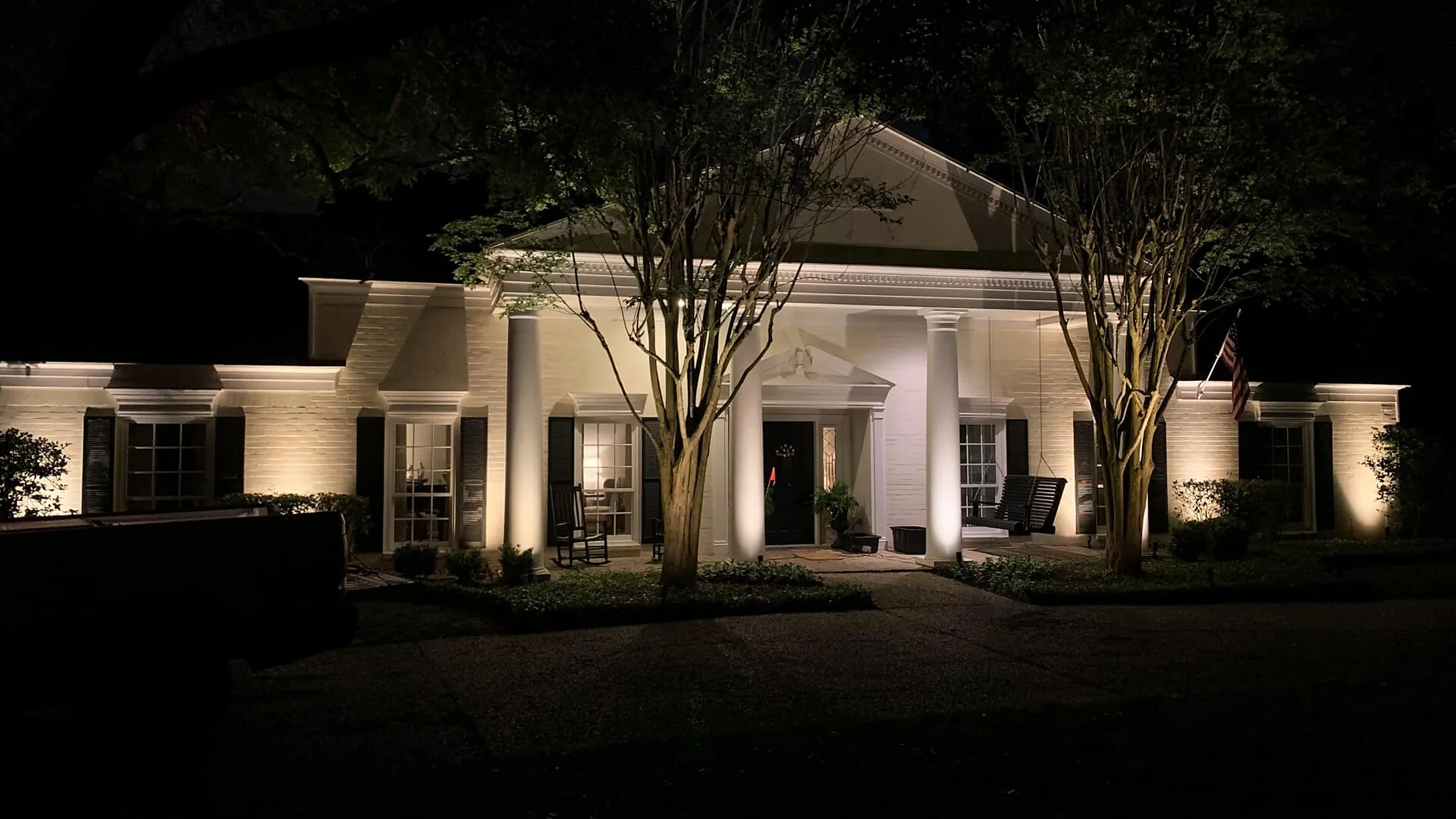
Buildings & facades
Columns, stone, brick, panels, rooflines and entrances, lit to the material rather than to a brightness level.
Architecture, signs, entrances, walkways, courtyards, trees and gathering areas — lit so visitors can find their way, and so the property still looks like the business inside it after dark.
Good commercial lighting does several things at once: it helps people understand where they are going, makes the entrance and the sign easy to identify, gives the architecture and planting something to do after dark, and makes the property look deliberate.
We look at the whole site before any of it gets specified:
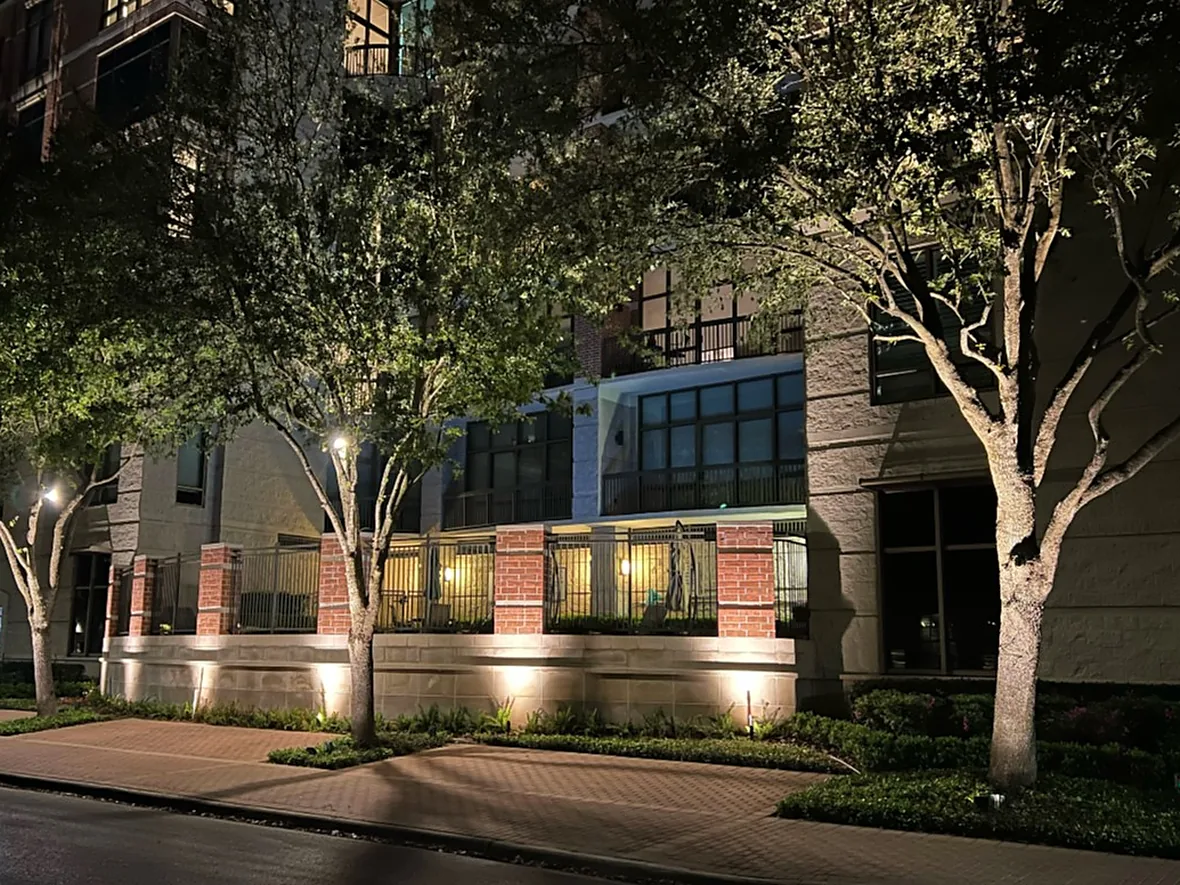
Can they identify the building from the road? Does the entrance stand out from the rest of the elevation? Is the sign readable at the distance people read it from? Does the landscaping simply disappear at sunset?
Those are business questions more than lighting questions, which is why the approach, the entrance and the sign usually get designed first.
Columns, stone, brick, panels, rooflines and entrances, lit to the material rather than to a brightness level.
Monument signs, building identification and address features, legible from where people read them.
Specimen trees, beds and planting that otherwise vanish the moment the sun goes down.
Routes, steps and transitions — useful light, without a runway of identical fixtures.
Seating, dining and event space that people will actually use after dark.
Moving water and the planting around it, lit so the feature is not one bright object in the dark.
Office and professional buildings, retail and customer-facing property, restaurants and hospitality, apartment and mixed-use entrances, churches and religious campuses, and larger campuses with several buildings and long approaches.
The brief changes with the type. Retail wants the entrance and sign to carry; hospitality wants the outdoor spaces to feel usable; a campus wants people to understand the route from the car park to the right door.
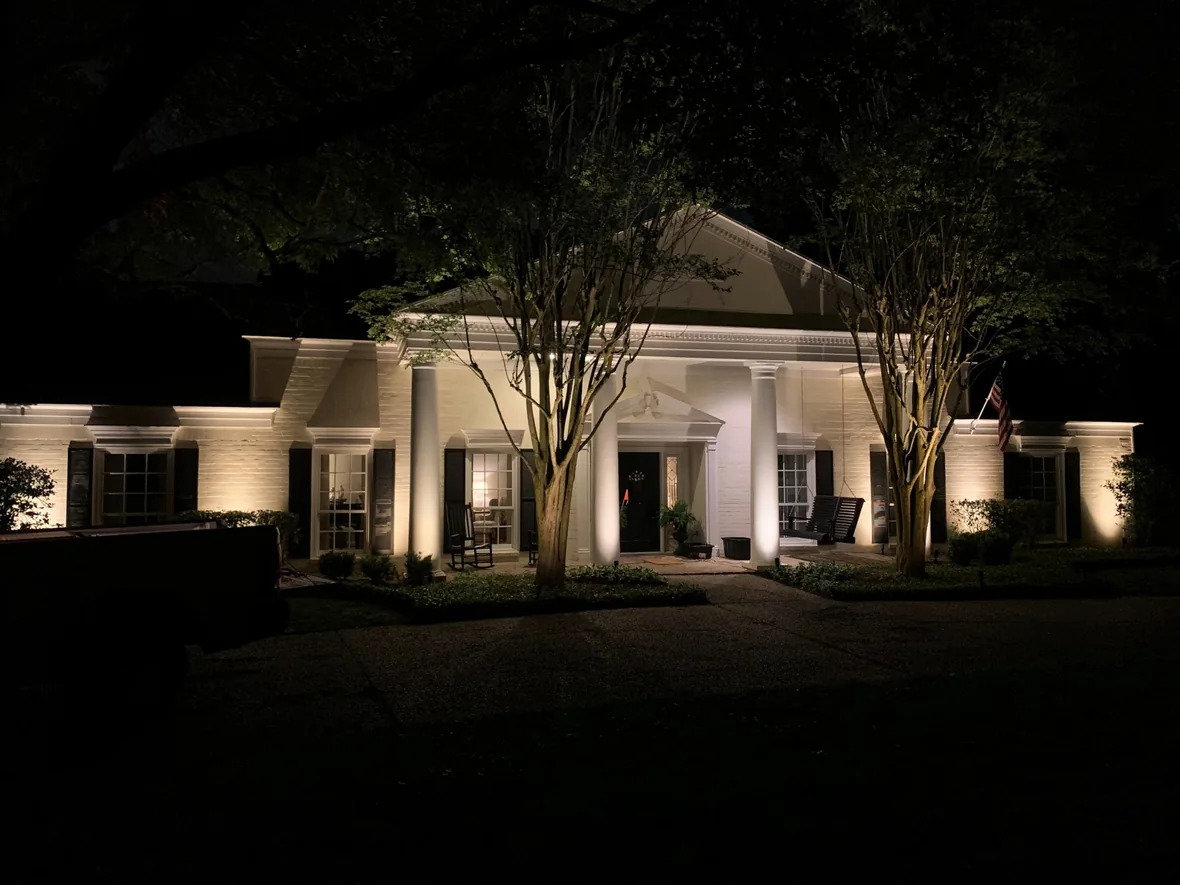
Commercial fixtures on a Houston property live through heat, humidity, heavy rain and occasional flooding across forecourts and beds. Fixture quality, mounting, watertight connections and wire routing decide whether the property still looks right in five years.
Low-voltage LED keeps running costs and lamp replacement down, and makes zones and schedules straightforward to add where opening hours vary.
On a commercial property, two dark fixtures on a facade are visible to every visitor. Regular service — cleaning, re-aiming, voltage checks, replacing what has failed — matters more here than on a house, and usually runs on a schedule rather than a phone call.
We specialise in landscape, architectural, accent, walkway, courtyard and sign lighting. Large high-voltage parking-lot and roadway pole lighting is a different electrical scope and we do not take it on.
Send the project details and we will tell you plainly whether it falls inside what we do — including when part of it does and part of it does not.
The largest surface on the property: facades, columns, stone, panels, rooflines and entrances.
Two fixtures out on a facade reads badly to every visitor arriving after dark.
Commercial systems need a rhythm rather than a call-out — cleaning, re-aiming, voltage checks.
Zones and schedules for opening hours, plus colour for a holiday or an event.
Older metal-halide and halogen site lighting converted without starting over.
Finished commercial work across Greater Houston: buildings, signs, entrances and courtyards.
Offices and professional buildings, retail, restaurants and hospitality, apartment and mixed-use entrances, churches and religious campuses, and larger campuses with several buildings.
Building facades, entrances, monument signs, landscaping, trees, walkways, courtyards, fountains and outdoor gathering spaces.
No. High-voltage parking-lot and roadway lighting is a different electrical scope. Send us the details and we will say whether the rest of the project is something we do.
Yes. Most of the work happens outside business hours or around the areas in use, and the night-time review is after dark anyway.
Yes, on suitable elements, with the everyday setting staying warm and neutral. Smart & Color-Changing Outdoor Lighting
Yes, usually on a regular rhythm rather than call-out by call-out. Maintenance & Repair
Often, keeping the wiring and positions that are sound. LED Upgrades & Retrofitting
It depends on the size of the property, the number of areas being lit, the fixtures and the wiring. A walk of the site is the shortest route to a real number.
We look at the approach, the entrance, the sign and the elevation the way a visitor arriving at eight in the evening sees them — and design from there.