
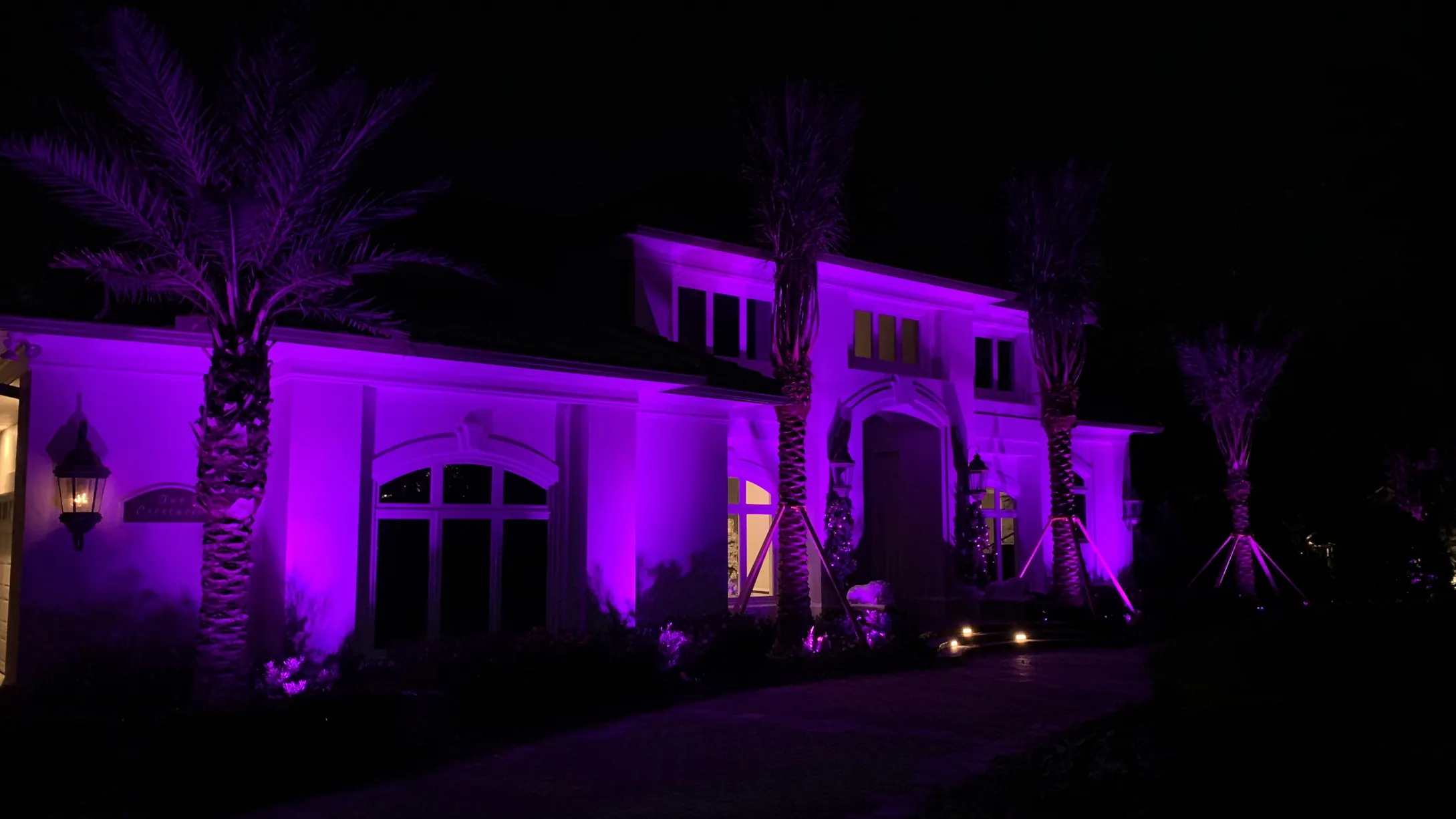
Landscape Lighting Design
The design comes first: controls decide when and how much, not what should be lit.
Schedules, zones, dimming and colour for holidays and events. The everyday setting stays warm and natural, because technology does not rescue a weak design.
Before apps, colours and zones, the property has to be lit properly: architecture, trees, planting, outdoor living areas, routes.
Controls decide when the system runs, which parts of it run and at what level. They do not decide what should be lit — and a colour-changing fixture pointed at the wrong feature is still pointed at the wrong feature.
Older systems had one behaviour: a timer switched everything on, then off. A modern system can run a schedule that follows sunset, hold different hours for different areas, dim, and be operated from a phone or a remote when you want something other than the default.
Plenty of properties need nothing more than reliable hours and a photocell. A basic system does not have to become a smart-home project, and adding controls nobody uses is a cost with no return.
The useful question is what you actually want to change from one evening to the next — and for many homeowners the answer is nothing.
Zoning is the control feature that earns its place most often. The front elevation can run until midnight while the backyard stays on later; the outdoor kitchen comes up only while you are cooking; holiday fixtures sit on their own circuit and never interfere with everyday light.
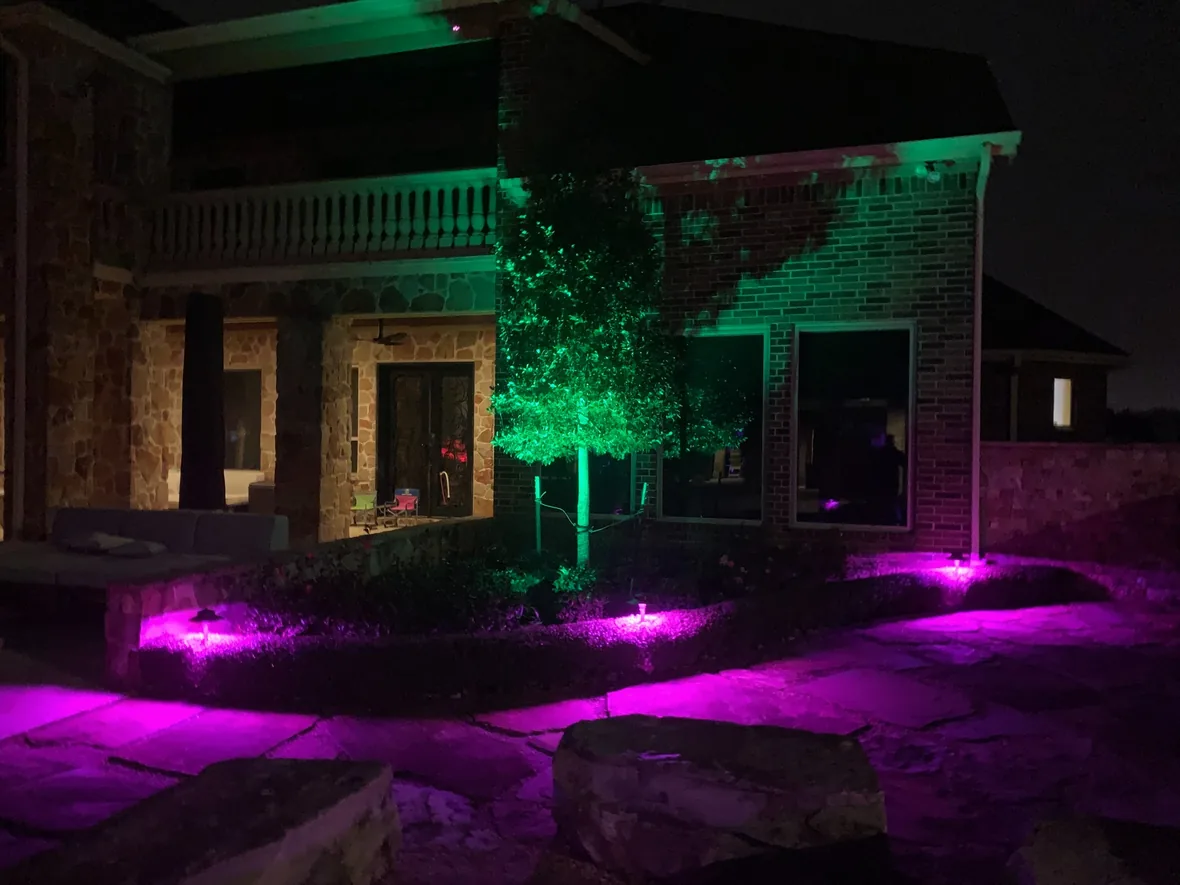
Colour-changing LED fixtures can wash a facade, a wall or a tree in a chosen colour for a holiday, a game day, a party or an event — and switch back to warm white the rest of the year.
The rule we hold to: everyday lighting stays warm and natural. Colour is an event setting, not a design. A property that is magenta every night reads as a venue, not a home.
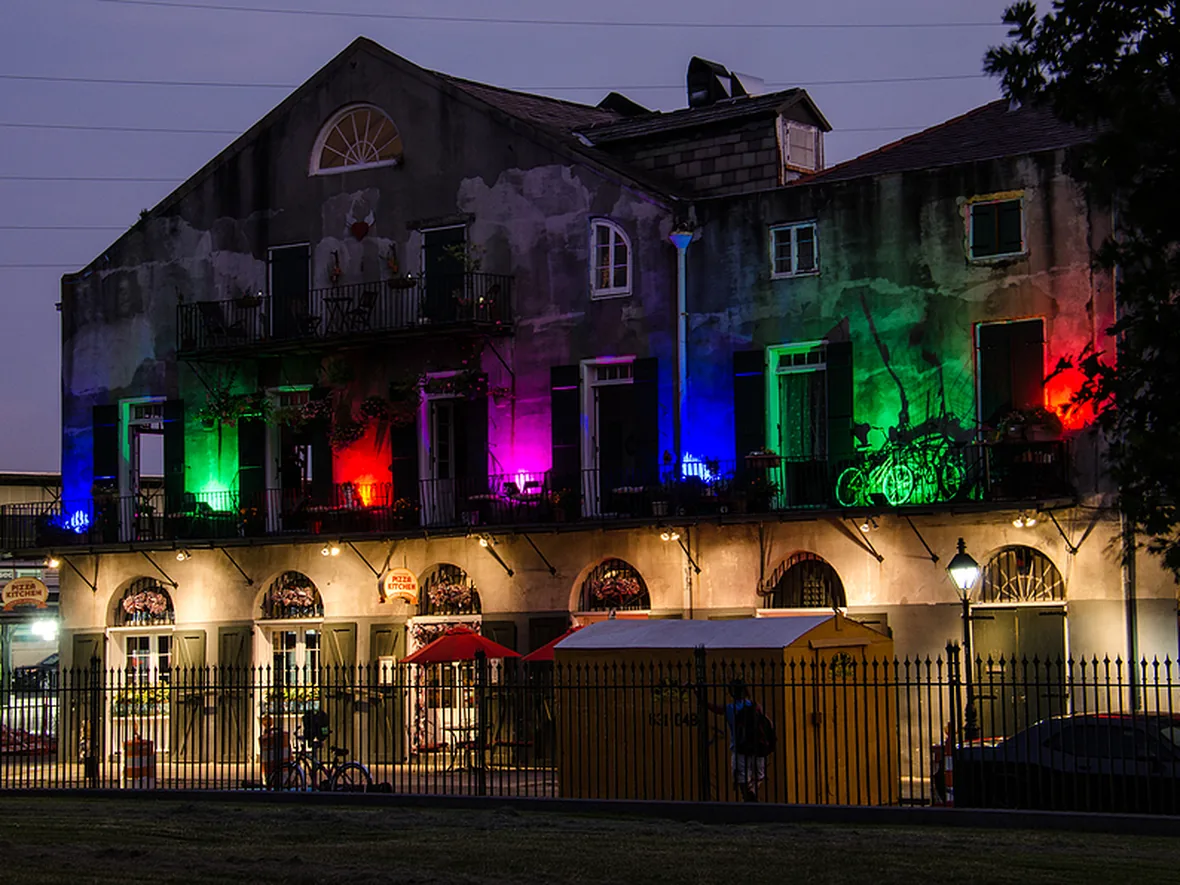
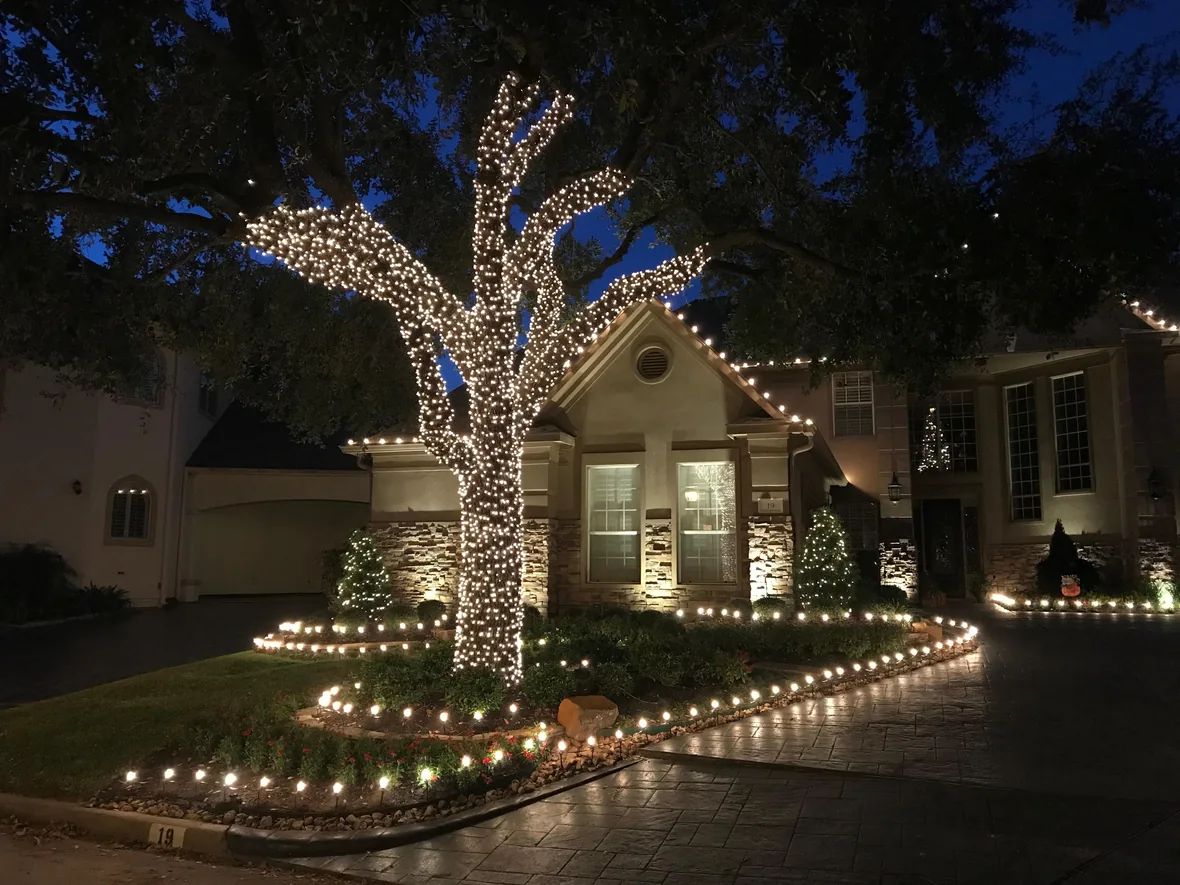
Saved scenes make the seasonal work trivial: a holiday setting, a game-day setting, a party setting, each recalled without re-aiming anything or hanging temporary fixtures.
Trees take colour well and architecture takes it selectively — one wall or one specimen carries an evening better than every surface on the property at once.
Dimming solves problems that would otherwise need different fixtures: an uplight that is slightly too strong on a pale wall, a patio that wants less light after dinner, a pool area that should drop once people are in the water.
It also extends the life of the everyday setting — most systems that feel overlit are simply running at full output because they have no other option.
The design comes first: controls decide when and how much, not what should be lit.
Zones and dimming are what let one patio serve a quiet evening and a full backyard.
Colour on a canopy is the loudest thing on a property — worth one tree, rarely five.
Facade washes for a holiday, over architecture that reads warm the rest of the year.
Controllers, zones and the wiring that has to exist before any of this is possible.
Adding control to an older system, or converting halogen fixtures that cannot take it.
Controls that give you more than a manual switch: programmable schedules, zones, dimming, saved scenes and operation from an app or remote.
No. A timer and a photocell are enough for many systems, and a simple system does not have to become a smart-home project.
Separately controlled groups — front, back, patio, trees, holiday fixtures — so different areas can run on different hours and levels.
Yes, with colour-changing LED fixtures on the features that suit it. We keep the everyday setting warm and natural and treat colour as an event setting.
Rarely. One wall, one tree or the front elevation carries an evening; everything at once reads as a venue rather than a home, and it costs considerably more.
Often, depending on the transformer, wiring and fixtures. Older halogen systems usually need converting first. LED Upgrades & Retrofitting
It is the most useful control feature: it fixes an uplight that is slightly too strong, drops a patio after dinner, and keeps a system from running at full output every night.
Yes — that is what an astronomical schedule or a photocell is for, instead of resetting a fixed start time every few weeks.
A timer is enough for plenty of properties. If you want zones, scenes and colour, they should be specified with the design rather than bolted on afterwards.